 Nederland
 België
 France
 Deutschland
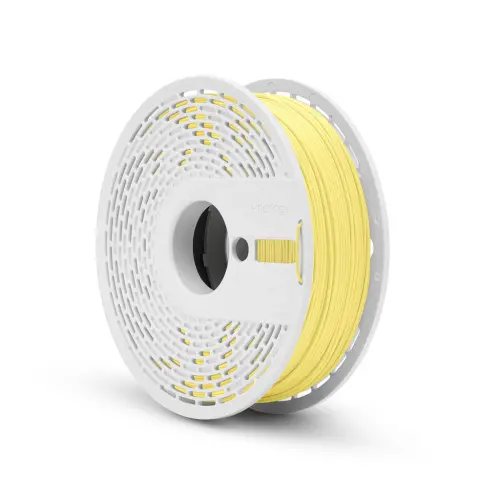
What is PETG filament?
PETG stands for polyethylene terephthalate glycol. It is related to PET, the plastic used for soft drink bottles; the added glycol makes the material less brittle, clearer and easier to print. PETG combines the ease of printing of PLA with more strength and toughness: a part will bend before it breaks. It resists moisture and many chemicals and keeps its shape up to around 70 °C.
PETG or PCTG?
PCTG is a copolyester from the same family. It prints almost the same, but is far more impact-resistant: Fiberlogy PCTG reaches around 90 kJ/m² in the notched Izod test, against 5–8 kJ/m² for PETG. It is also slightly more heat-resistant (up to around 76 °C) and clearer. Choose PETG for most functional printing and PCTG for parts that have to withstand knocks, vibration or a fall. Our article PCTG vs PETG covers the differences in detail.
Which type should you choose?
| Type | Suitable for |
|---|---|
| PETG | Most functional printing: holders, enclosures and parts. Easy PETG from Fiberlogy and Fill 3D PETG, also in transparent colours. |
| PETG Matte | Strong prints with a matte finish on which layer lines barely show. |
| PCTG | Impact-resistant parts that need to take a knock, also in clear transparent colours. |
| PETG + CF | Stiff, dimensionally stable parts with carbon fibre and a matte, technical look. |
| PCTG + CF / GF | Technical parts with carbon or glass fibre, for extra stiffness and heat resistance. |
| PETG special | ESD against electrostatic discharge, PTFE for low friction and CPE HT for temperatures up to 110 °C. |
Fiberlogy or Fill 3D?
Fiberlogy makes premium filament with a diameter tolerance of ± 0.02 mm and a roundness tolerance of 0.01 mm. Easy PETG prints almost as easily as PLA, with little stringing, and many colours are also available as a refill. A few colours also come in 2.85 mm, and R PETG is made from 100% recycled material. Fill 3D is our own brand: a reliable, good-value PETG in solid and transparent colours, on 0.5 and 1 kg spools.
Printing PETG and PCTG: the right settings
- Nozzle: PETG usually between 230 and 260 °C (Fiberlogy Easy PETG 230–250 °C, Fill 3D PETG 230–260 °C). PCTG, PETG Matte and the reinforced types 250–270 °C.
- Print bed: PETG around 70–90 °C, PCTG 90–110 °C.
- Adhesion: PETG can stick so well to a smooth PEI sheet that it damages the surface. Print on a textured sheet or use a layer of glue stick as a release agent.
- Cooling: less than with PLA, around 30–50%. Too much cooling weakens the bond between layers.
- Nozzle for CF and GF: carbon and glass fibre wear a brass nozzle quickly; use a hardened steel nozzle.
- Enclosure: not needed for PETG and PCTG.
The exact temperatures are listed with each product. Something going wrong? Our article on solving 3D printing problems covers the most common problems and how to fix them.
Properties of PETG: the pros and cons
Pros
- Stronger and tougher than PLA
- Keeps its shape up to around 70 °C, PCTG up to around 76 °C
- Resists moisture and many chemicals, and suitable for outdoor use
- Little shrinkage and warping, no enclosure needed
- Good bonding between layers
- Also available in clear, transparent colours
Cons
- A little trickier than PLA: more prone to stringing
- Can stick too well to a smooth print bed
- Absorbs moisture and then prints less well, so store it dry
- Less stiff than PLA; for stiff parts choose a CF variant
Uses of PETG and PCTG
- Functional parts: holders, brackets, clips and hinges.
- Enclosures: for electronics, sensors and project boxes.
- Outdoors: parts for the garden, bike, boat or camper.
- Mechanical: gears and guides with PETG + PTFE, impact-resistant parts with PCTG.
- Transparent: lampshades, vases and light diffusers.