 Nederland
 België
 France
 Deutschland

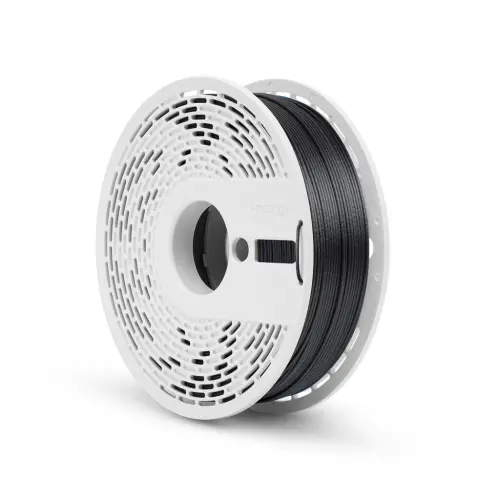
What is PLA CF?
PLA CF (also PLA-CF or carbon PLA) is PLA with short carbon fibres in it. Fiberlogy PLA + CF contains 10% carbon fibre. The fibres make the material stiffer and reduce shrinkage and warping, so parts stay true to size. The surface becomes a matte, even black, with layer lines that are almost invisible. According to Fiberlogy it is also suitable for high-speed printing and more heat-resistant than regular PLA.
PLA CF or another filament?
| Filament | Choose it for |
|---|---|
| Standard PLA | Most printing, in many colours. More flexible and cheaper than PLA CF. |
| PLA CF | Stiff, dimensionally stable parts with a clean, matte look, as easy to print as PLA. |
| PETG + CF | Stiff parts that also need to be tough and more resistant to heat and moisture. |
| Nylon + CF / GF | Heavily loaded technical parts. Stronger, but harder to print. |
Printing PLA CF: what to look out for
- Nozzle: carbon fibre wears a brass nozzle quickly. Use a hardened steel nozzle of 0.4 mm or larger.
- Temperature: use the nozzle and bed temperatures stated on the spool label.
- Cooling: as with PLA, plenty of cooling.
- Enclosure: not needed.
- Diameter: 1.75 mm, with a diameter tolerance of ± 0.02 mm and a roundness tolerance of 0.01 mm.
This spool fits in the Bambu Lab AMS. Something going wrong? Our article on solving 3D printing problems covers the most common problems and how to fix them.
Pros and cons of PLA CF
Pros
- Stiffer than regular PLA
- Little shrinkage and warping, so dimensionally stable
- Matte surface on which layer lines barely show
- Prints almost as easily as PLA, without an enclosure
Cons
- Requires a hardened nozzle
- A stiff material flexes less and can break sooner on impact; for impact-resistant parts choose PLA Impact
- It is still PLA: for hot places or outdoors choose PETG + CF or ASA
Uses of PLA CF
- Frames and structures: drone and RC parts, frames and supports.
- Workshop: jigs, drill guides and assembly aids that need to be dimensionally accurate.
- Brackets and holders: for cameras, tools and electronics.
- Prototypes: functional models with a professional, matte finish.
You will find more types of PLA in our PLA filament.