 Nederland
 België
 France
 Deutschland

What is PETG CF?
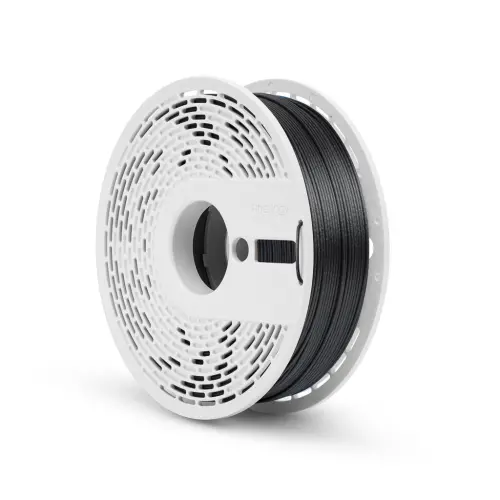
PETG CF, also called PETG carbon or PETG + CF, is PETG with short carbon fibres added. Fiberlogy PETG + CF contains 10% carbon fibre. The fibres make the material stiffer: a part bends less under load and holds its dimensions better. The base is still PETG, so the chemical resistance and ease of printing are largely retained. The filament is black and comes on a 0.75 kg spool. You can read more about PETG in general under PETG & PCTG filament.
PETG CF or another fibre-reinforced filament?
| Filament | Characteristic | Choose it for |
|---|---|---|
| PETG + CF | Stiff and dimensionally stable, with a tough PETG base | Brackets, holders and enclosures for everyday use |
| PCTG + CF / GF | More impact-resistant PCTG base, with carbon or glass fibre | Parts that also have to absorb knocks or vibration |
| PLA + CF | The easiest to print, but less heat-resistant | Models, moulds and prototypes for indoor use |
| Nylon + CF / GF | Strong and wear-resistant, but harder to print | Heavily loaded parts |
Printing PETG CF: the settings
- Nozzle: 250–270 °C.
- Print bed: 90–110 °C.
- Hardened nozzle: carbon fibre is abrasive and wears a brass nozzle quickly. Use a hardened steel nozzle or another wear-resistant material. A 0.6 mm nozzle reduces the risk of clogging.
- Adhesion: print on a textured sheet or use glue stick as a release agent, as with ordinary PETG.
- Cooling: moderate; too much cooling weakens the bond between layers.
- Diameter: 1.75 mm, with a tolerance of ± 0.02 mm.
Dealing with stringing, clogging or poor adhesion? Solving 3D printing problems covers the causes and fixes.
Pros and cons of PETG CF
Pros
- Stiffer and more dimensionally stable than ordinary PETG
- Little shrinkage and warping during printing
- Matte surface that makes layer lines and small imperfections less noticeable
- According to Fiberlogy, more heat-resistant than standard PETG
Cons
- Abrasive: a hardened nozzle is needed
- Less elongation than ordinary PETG; for parts that need to flex or absorb knocks, PETG or PCTG is better
- Only in black
- Absorbs moisture, so store it dry
Uses
- Functional parts: brackets, holders, frames and enclosures.
- Workshop: moulds, jigs and fixtures that need to hold their dimensions.
- Hobby: parts for drones, RC models and the car.
- Engineering: guides and gears that should flex as little as possible.