Nederland
 België
 France
 Deutschland
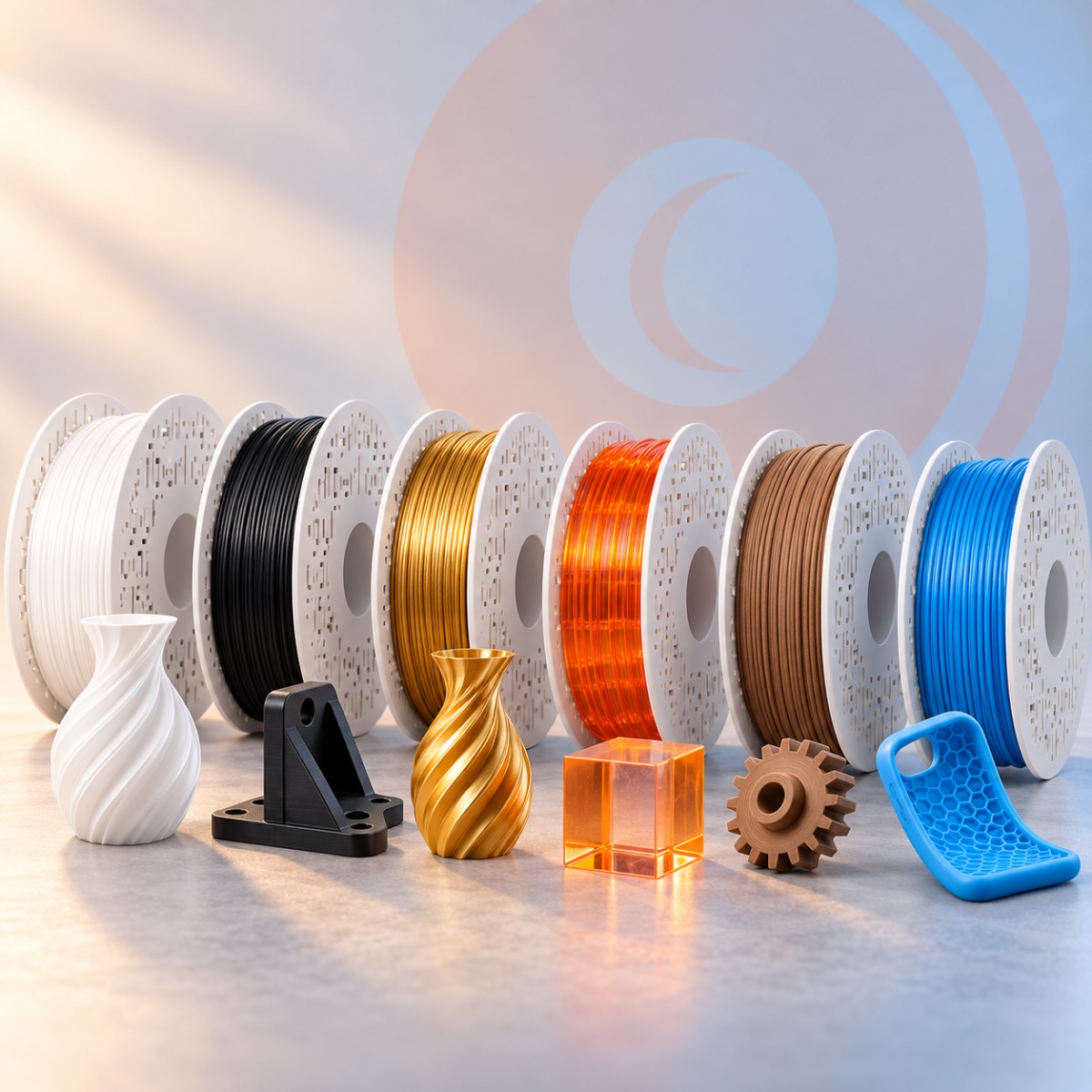
Short answer: start with PLA for decoration and prototypes, choose PETG for functional parts, ASA for anything that lives outdoors and TPU for flexible prints. For demanding technical parts there is technical filament such as nylon and PP. Don't want to work it all out yourself? Answer 5 short questions in our filament guide and you will see straight away which material suits you best.
Three questions that decide your choice
Which filament is best does not depend on the material itself, but on your print. So first ask yourself these three questions:
- Where will the print be used? Indoors on a shelf, in a hot car or outside in the sun? Heat and UV light quickly rule out certain materials.
- What does the print need to do? Look good, be sturdy, absorb knocks, flex or resist wear?
- What can your printer handle? An open printer prints PLA, PETG and TPU just fine. For ABS and nylon an enclosed printer is better, and for filament with carbon or glass fibre you need a hardened nozzle.
Types of filament at a glance
| Material | Ease of printing | Strength | Heat resistance | Outdoors | Enclosed printer |
|---|---|---|---|---|---|
| PLA | Very easy | Stiff but brittle | Low (approx. 55 °C) | No | Not needed |
| PLA Impact | Very easy | Tougher than PLA | Low | No | Not needed |
| PETG | Easy | Strong and tough | Medium (approx. 70 °C) | Fair | Not needed |
| PCTG | Easy | Very impact resistant | Medium (approx. 76 °C) | Fair | Not needed |
| ABS | Moderate | Strong | High | Moderate (not UV resistant) | Yes |
| ASA | Moderate | Strong | High | Very good | Recommended |
| PC/ABS | Demanding | Very strong | Very high | Good | Yes |
| TPU / flex | Moderate | Flexible and wear resistant | Medium | Good | Not needed |
| Nylon PA12 | Demanding | Very tough and wear resistant | High | Good | Recommended |
| PP | Demanding | Tough, light and chemical resistant | Medium | Good | Not needed |
A general comparison. The exact print temperatures for each product are on the spool and in the product specifications.
PLA: easy, good-looking and versatile
PLA is the filament most people start with, and for good reason. It prints at a low temperature, hardly shrinks, doesn't smell and is very forgiving. It comes in most colours and finishes. The downside: PLA softens from around 55 °C and is fairly brittle. For a dashboard in summer or a part that takes knocks, choose something else.
- Standard PLA for everyday prints, prototypes and models.
- PLA Matte hides layer lines and gives a calm, professional look.
- Silk and Satin for glossy, decorative prints.
- Wood PLA contains wood fibres and looks like real wood.
- PLA Impact is much tougher than regular PLA, yet prints just as easily.
- PLA + CF is extra stiff and matte. Note: use a hardened nozzle.
PETG and PCTG: strong for everyday use
PETG is the logical next step after PLA. It is stronger and tougher, more resistant to heat and moisture, and still prints on an open printer. That makes it ideal for holders, enclosures, brackets and parts for home or workshop. PCTG is related to PETG, but far more impact resistant and clearer. Can't decide between the two? Read PCTG vs PETG: the differences and when to choose which filament. Need extra stiffness? Look at PETG + CF or PCTG + CF/GF.
ABS, ASA and PC/ABS: for heat and outdoor use
If your print has to withstand heat, for example in a car or close to a motor, this is the group for you. ABS is strong and heat resistant, but shrinks while printing. An enclosed printer and good ventilation are therefore recommended. ASA has the same advantages and is also UV resistant, so it doesn't discolour or turn brittle in the sun: the best choice for garden, balcony, caravan and car. PC/ABS is even stronger and more heat resistant, but asks more of your printer.
TPU: flexible filament
TPU is rubbery and flexible. Use it for phone cases, caps, gaskets, shock absorbers and non-slip feet. Hardness is given in Shore: 30D is softer and more flexible, 40D is firmer. Print flexible filament slowly, preferably with a direct drive extruder. An automatic system such as the AMS is often not suitable for soft filament; check this for your own printer.
Technical filament: nylon, PP, soluble and ESD
For parts that really have to take a beating, there is technical filament.
- Nylon PA12 is very tough and wear resistant, ideal for gears, hinges and moving parts. With carbon or glass fibre it also becomes very stiff.
- PP is light, tough and resistant to many chemicals. It suits containers, caps and hinges that flex often.
- Soluble filament is used as support for complex shapes on a printer with two materials. After printing, you dissolve it.
- ESD-safe filament dissipates static charge and is meant for holders and enclosures around electronics.
Choose by application
- Decoration, figures and gifts: PLA, PLA Matte, Silk or Wood.
- Prototypes and models: standard PLA or PLA Matte.
- Functional parts for indoors: PETG, or PLA Impact if toughness matters most.
- Parts that must survive knocks or drops: PCTG.
- Outdoors, in the sun or in the car: ASA.
- High temperatures: ABS or PC/ABS.
- Flexible or shock absorbing: TPU 30D or 40D.
- Moving and wearing parts: nylon PA12.
- Transparent: PCTG Pure Transparent, HS PLA Clear or transparent PETG.
Tip: dry filament prints better
Almost every filament absorbs moisture from the air, and PETG, PCTG, TPU and nylon are especially sensitive. Wet filament crackles while printing, strings more and gives a rough surface. Store your spools sealed with silica gel beads.
Still unsure? Use the filament guide
Still not sure which material suits you best? Our filament guide asks you 5 short questions about your print and your printer. You then see which of our materials fits best, with the spools you can order right away. Prefer to browse yourself? Our range of 3D printer filament brings together every material from Fiberlogy and Fill 3D.