Nederland
 België
 France
 Deutschland

Is your printer crackling, has your PETG suddenly started stringing, or does your TPU print look bumpy? There is a good chance your filament has absorbed moisture. Almost every filament takes up moisture from the air, but some materials do so much faster than others. In this blog you will read which filament needs drying, at what temperature and for how long, and how to keep it dry afterwards.
Why is moisture in filament a problem?
Filament that has absorbed moisture literally starts to boil in the hot nozzle. The water turns into steam, and you can hear and see it: crackling or hissing at the nozzle, small bubbles and holes in your print, more stringing and a rough or dull surface. The layers also bond less well, which makes your print weaker. With some materials the filament even becomes brittle and snaps on the spool or in the extruder.
How do you recognise damp filament?
- You hear crackling, popping or hissing as the filament leaves the nozzle.
- You see bubbles, holes or a foamy surface.
- You get much more stringing than usual.
- The surface is rough or less glossy.
- The layers bond poorly and the print breaks easily.
- The filament is brittle and snaps when you bend it.
Recognise a few of these points? Then drying is the first step, even before you start changing your settings. You can find more causes of print problems in solving common 3D printing problems.
Which filament is sensitive to moisture?
Not every filament is equally sensitive. Here are the materials from our range, from barely to very sensitive:
- PLA and PP: barely sensitive. PLA absorbs moisture very slowly. In practice it hardly matters for PLA, unless a spool has been left open in a damp room for months. PP absorbs even less moisture.
- ABS and ASA: moderately sensitive. They do absorb moisture, but you will notice it less quickly than with PETG.
- PETG and PCTG: sensitive. Here moisture mainly shows up as extra stringing, bubbles and a rough surface. Drying is almost always worth it. Read more about this material in printing PETG.
- TPU (FiberFlex): very sensitive. Flexible filament absorbs moisture quickly. If a spool has been left open for a few days, you will often already notice stringing and a bumpy surface.
- Nylon (PA12) and BVOH: extremely sensitive. These materials soak up moisture like a sponge. Fiberlogy recommends printing nylon directly from a dryer or a well-sealed box.
Drying temperature and drying time per material
These are the drying values Fiberlogy specifies for its filaments:
| Material | Moisture sensitivity | Temperature | Drying time |
|---|---|---|---|
| PLA (Easy PLA, Impact PLA, PLA Matte) | Low | 50 °C | 4 hours |
| FiberSilk and FiberSatin | Low | 40 °C | 4 hours |
| FiberWood | Low | 50 °C | 4 to 6 hours |
| PETG, PCTG and CPE HT | Medium | 60 °C | 4 hours |
| ABS | Moderate | 60 °C | 4 hours |
| ASA | Moderate | 80 °C | 4 hours |
| TPU (FiberFlex 30D and 40D) | High | 60 °C | 4 hours |
| Nylon PA12 | Very high | 70 °C | 4 hours |
| PA12 + CF15 and PA12 + GF15 | Very high | 80 °C | 4 hours |
| BVOH | Very high | 50 °C | 4 hours |
Note: FiberSilk and FiberSatin are dried at a lower temperature than regular PLA, at 40 °C. Always stick to the temperature. Drying hotter is not faster, but it can soften the filament so that the windings stick together or the spool deforms.
For Fill 3D PLA and Fill 3D PETG, use the PLA and PETG values as a starting point. If a spool has been open for a long time and is really damp, feel free to extend the drying time a little. If a product lists different drying advice, that advice takes priority.
Drying PLA: is it necessary?
Usually not. PLA absorbs moisture so slowly that a spool you use regularly and put back in its bag after printing will keep printing just fine. Drying only makes sense if you see or hear the familiar signs, or if a spool has been left open for a long time in a shed or garage, for example. In that case, 4 hours at 50 °C is enough. Read more about PLA in our PLA filament tips.
Drying TPU (FiberFlex)
With TPU, drying is pretty much standard. Dry FiberFlex 30D and 40D for 4 hours at 60 °C. Because TPU absorbs moisture again so quickly, it is best to print it directly from the dryer for long prints. Both filament dryers in our range have a feed-through to the printer for this. After printing, the spool goes straight back into an airtight bag or box with silica gel beads.
Should you dry a new spool too?
The advice I often give: yes, dry a new spool too, especially with PETG, PCTG, TPU and nylon. If it doesn’t help, it doesn’t hurt.
That says nothing about the quality of the filament. It is dried during production and sealed in its packaging with a bag of desiccant. But there is often quite some time between the factory and your printer: transport, storage in a warehouse and with us, and sometimes a while on your own shelf. During that time some moisture can still creep in:
- Plastic film is not one hundred percent vapour-tight. Over a longer period, a little moisture can very slowly pass through.
- A bag of desiccant can only absorb a limited amount of moisture. Once it is full, it no longer protects.
- A tiny hole or a seam that is not completely closed is invisible, but it is enough to let moisture in.
You can’t see that from the outside of the spool. A few hours of drying costs little, while a failed ten-hour print costs a lot more. That is why my advice is: dry it to be on the safe side. With PLA you can usually skip this step.
How do you dry filament?
With a filament dryer
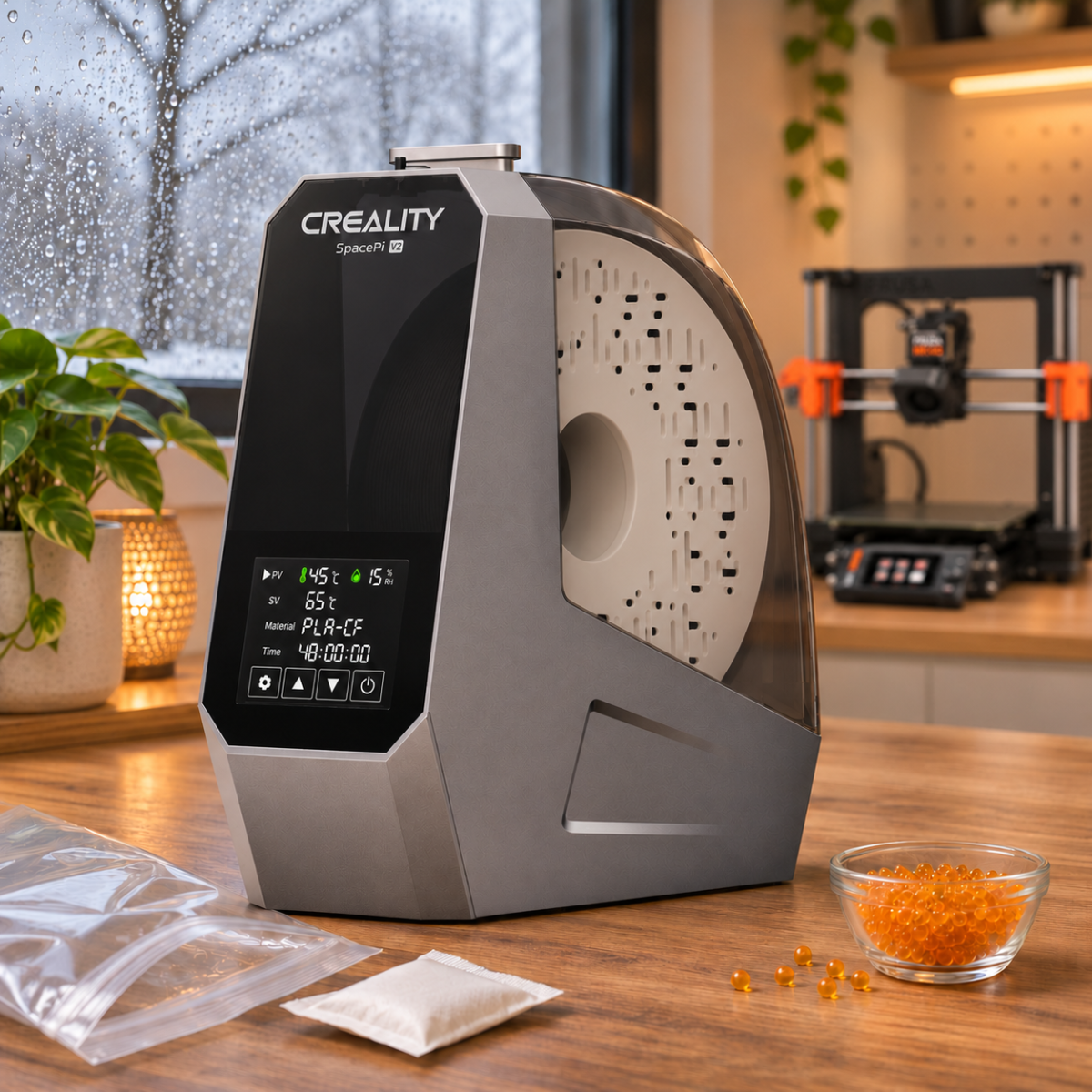
This is the easiest and safest method. A filament dryer keeps the temperature constant and blows warm air around the spool. The Creality SpacePi SE goes up to 65 °C and is more than enough for PLA, PETG, PCTG, ABS and TPU. If you also print nylon, choose the Creality Space Pi V2: it goes up to 75 °C. With both dryers you can keep drying while you print, with the filament running through the feed-through to your printer.
For ASA and PA12 with carbon or glass fibre, Fiberlogy specifies 80 °C. These dryers don’t get that hot. In that case, dry those materials at the highest setting and allow a bit more time.
In the oven
It can be done, but be careful. The thermostat of a household oven is often inaccurate at low temperatures, and just a few degrees too hot can already deform your spool or make the filament stick together. Check the temperature with a separate thermometer and stay close by. A food dehydrator is sometimes used as well, if it gets warm enough.
How do you keep filament dry?
Drying only helps if you also store the filament dry afterwards. Otherwise it simply starts absorbing moisture again.
- Back in the bag. Put a spool back into its resealable bag with the desiccant right after printing.
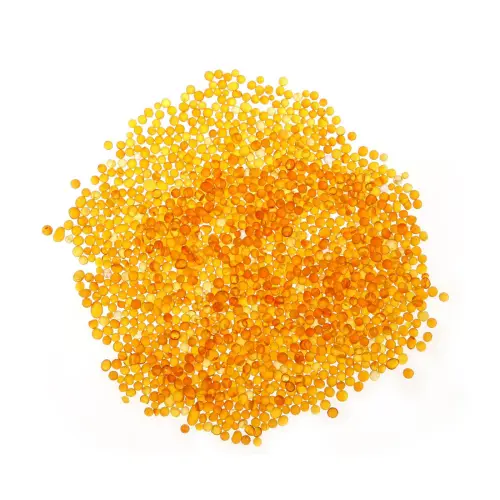
- Silica gel beads. Add a good scoop of silica gel beads to your bag or storage box. They absorb moisture from the air and change colour when they are full. You can then make them usable again by placing them in a ventilated oven at a maximum of 80 °C for about 3 hours, until they are orange again. Silica gel keeps dry filament dry, but it does not dry damp filament quickly. For that you need a dryer.
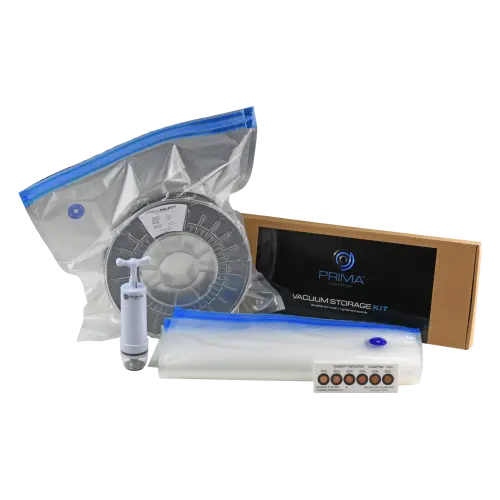
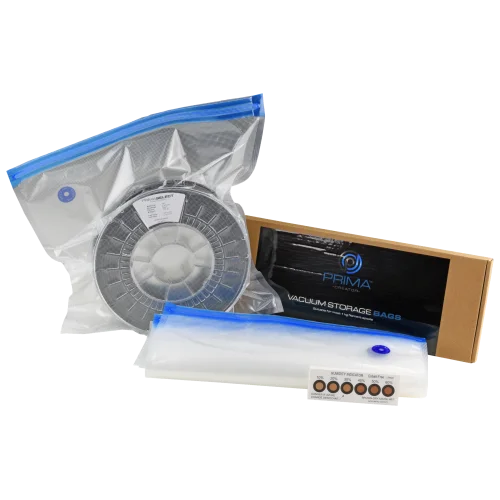
- Store it airtight. With the PrimaCreator Air Tight Filament Storage Set or the PrimaCreator Filament Storage Bags, you can store spools you are not using airtight.
- Choose the right spot. A cold shed, garage or attic is often damper than your living room. If your spools are kept there, airtight storage is extra important.
How quickly does filament become damp again?
That depends on the material and the humidity. Nylon and TPU can absorb moisture again within hours to a few days if they are left open. PETG and PCTG last longer, and PLA can be left open for weeks without you noticing anything. So always store a spool you are not using airtight.
In short: don’t worry too much about PLA, but take moisture seriously with PETG, PCTG, TPU and nylon. A dryer and a scoop of silica gel beads save you a lot of hassle and failed prints. You can find everything for drying filament and keeping it dry in the filament storage & drying category. Happy printing! :)